
- Empty cart.
- Continue Shopping

Roughhousing — What It Is, Why It Is Important and How to Try It in Your Family
- Posted on
Azhar Mehmood
- 0
- Categories: Blog
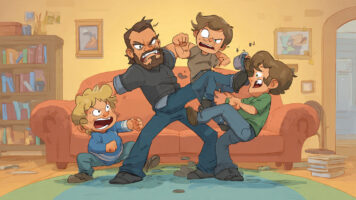
I’ll never forget the first time I really understood the power of roughhousing. My son was about five, and we’d just moved to a new city. He was struggling — quiet at preschool, clingy at home, and having trouble sleeping. One evening, out of pure desperation (and maybe a little caffeine-fueled energy), I grabbed him, threw him over my shoulder like a sack of potatoes, and declared myself a “tickle monster.”
What followed was fifteen minutes of pure chaos. Pillow fights. Wrestling on the carpet. Him trying to “escape” while I pretended to be the world’s slowest, clumsiest giant. We were both breathless and laughing so hard our stomachs hurt.
That night, he slept better than he had in weeks. The next morning, he woke up chatty and relaxed. And over the following days, I noticed something shift — he seemed lighter, braver, more himself again.
That’s when I realized: What is roughhousing? It’s not just play. It’s connection. It’s communication. It’s therapy disguised as fun.
So, What Is Roughhousing, Really?
At its core, roughhousing is physical play that involves tumbling, wrestling, chasing, tickling, and gentle “mock fighting” between a parent (or caregiver) and a child. It’s loud, messy, and a little wild — but it’s also structured, safe, and deeply meaningful.
It’s not about aggression or letting things get out of control. It’s playful combat with clear boundaries, lots of laughter, and an unspoken agreement: we’re doing this together, and everyone’s safe.
Dr. Anthony DeBenedet and Dr. Lawrence Cohen, authors of The Art of Roughhousing, describe it as “a way to connect with your child through play-fighting, tumbling, and horseplay.” They argue that this kind of physical play is one of the most powerful tools parents have for building trust, teaching emotional regulation, and helping kids develop resilience.
And the science backs this up. Studies show that roughhousing activates the prefrontal cortex — the part of the brain responsible for decision-making, impulse control, and emotional regulation. In other words, when kids roughhouse, they’re literally building the neural pathways that help them manage big feelings and navigate social situations.
Why Roughhousing Matters More Than You Think
- It Builds Emotional Resilience
Roughhousing teaches kids how to handle intensity. They learn to read social cues, navigate physical boundaries, and recover from being “knocked down” (literally and figuratively).
When my daughter was seven, she went through a phase where she’d burst into tears over the smallest things — a broken crayon, a lost game, a sibling looking at her the wrong way. I started incorporating more roughhousing into our routine. We’d wrestle, she’d “win,” I’d dramatically fall over, she’d laugh. Over time, I noticed her emotional responses became more balanced. She could handle disappointment better. She bounced back faster.
Research from the University of Washington found that children who engage in physical play with their parents show better emotional regulation and are less likely to develop anxiety or aggression issues.
- It Strengthens Your Bond
There’s something magical about shared laughter and physical closeness. Roughhousing releases oxytocin — the “bonding hormone” — in both you and your child. It creates a safe space where your child feels seen, heard, and loved in a way that’s different from verbal affirmation or quiet cuddles.
One of my favorite parenting books, Playful Parenting by Lawrence Cohen, emphasizes that play is the language of childhood. When you roughhouse with your child, you’re speaking their language fluently.
- It Teaches Self-Control and Boundaries
Here’s the beautiful paradox of roughhousing: it looks wild, but it requires incredible self-regulation. Kids learn to control their bodies, gauge their strength, and respect the word “stop.”
In our house, we have a rule: if anyone says “stop” or “enough,” the game ends immediately. No questions, no guilt. This has taught my kids that their boundaries matter — and that respecting others’ boundaries is non-negotiable.
- It Builds Confidence and Physical Literacy
Roughhousing helps kids understand what their bodies can do. They learn balance, coordination, spatial awareness, and strength. They also learn that falling down isn’t the end of the world — you just get back up.
My youngest was terrified of the playground for months. Too high, too fast, too scary. But after weeks of roughhousing at home — pillow pile crashes, couch cushion “mountains” to climb, being swung around in circles — he gained the confidence to try the slide. Then the monkey bars. Then everything.
Dr. Stuart Brown, founder of the National Institute for Play, found that children who engage in rough-and-tumble play develop better motor skills and show increased confidence in physical activities.
Common Fears (and Why They’re Mostly Unfounded)
“Won’t it make my child aggressive?”
No. In fact, the opposite is true. Roughhousing within clear boundaries teaches kids how to manage aggression, not amplify it. The key is that it’s playful, mutual, and stops the moment anyone feels uncomfortable.
“What if someone gets hurt?”
Minor bumps happen. That’s part of the learning. But serious injuries during supervised, intentional roughhousing are rare. You’re not throwing your child across the room — you’re rolling on the carpet, tickling, and pretending to be a “slow-motion dinosaur.”
“My child is too young/too old.”
Roughhousing can be adapted for any age. With toddlers, it might be gentle tumbling or “airplane rides.” With tweens, it might be pillow fights or wrestling matches (where they almost always win). The principle stays the same: connection through play.
How to Start Roughhousing in Your Family (Even If It Feels Awkward)
Step 1: Start Small and Simple
You don’t need a manual or a plan. Start with something silly: a tickle attack, a “chase me” game, or pretending to be knocked over by a hug.
Example: “I’m going to count to three, and then I’m coming to get you!” (Then chase them, catch them, and dissolve into laughter.)
Step 2: Set Clear Rules
Before you start, agree on the ground rules:
- No hitting, biting, or kicking
- If someone says “stop,” everyone stops
- We play on soft surfaces (carpet, grass, cushions)
- We check in with each other (“Are you okay? Want to keep going?”)
Step 3: Let Them Win (Sometimes)
Power dynamics matter. If you always dominate, the play becomes frustrating instead of fun. Let your child “overpower” you. Let them pin you down. Let them escape your “grasp.” This builds their confidence and keeps the play collaborative.
Step 4: Follow Their Lead
Some kids love full-on wrestling. Others prefer gentler games like “pillow fight” or “turtle flips.” Pay attention to what lights them up, and go with that.
Step 5: Keep It Playful, Not Competitive
This isn’t about winning or losing. It’s about connection. If things start feeling tense or aggressive, take a break. Laugh. Reset.
Roughhousing Ideas to Try Tonight
- Pillow Fight Frenzy: Soft pillows only. Last one standing wins (but everyone wins, really).
- Couch Cushion Mountain Climb: Stack cushions and let them “conquer” the mountain while you’re the “tickle monster” trying to stop them.
- Turtle Flips: Lie on your back, curl up like a turtle, and let them try to “flip” you over.
- Horseback Rides: Get on all fours and let them ride you around the room (back permitting!).
- Sock Wrestling: Everyone in socks. Try to gently pull each other’s socks off. Hilarious chaos ensues.
- Slow-Motion Chase: Chase them in exaggerated slow motion. They’ll love “escaping” and you’ll love not running full speed.
What I’ve Learned from Years of Roughhousing
Lesson 1: The messier the play, the deeper the connection. Don’t worry about perfect hair or a tidy living room. Worry about the laughter.
Lesson 2: Roughhousing is an emotional release valve. After a tough day at school, my kids don’t want to “talk about it” — they want to wrestle. And that’s okay.
Lesson 3: It teaches them that physical touch can be joyful and safe. In a world where kids are increasingly glued to screens, this matters.
Lesson 4: You’re never too old or too busy. Even five minutes of roughhousing can reset the mood in your home.
Lesson 5: It’s okay to feel awkward at first. I felt ridiculous the first few times I pretended to be a dinosaur. Now? It’s my favorite part of the day.
The Research Behind the Play
If you’re a “show me the evidence” kind of parent (I am too), here’s what the research says:
- A study published in Evolutionary Psychology found that father-child roughhousing is linked to better emotional regulation and social competence in children.
- Dr. Jaak Panksepp’s work on play neuroscience shows that rough-and-tumble play activates brain circuits that promote joy, bonding, and resilience.
- The Art of Roughhousing by DeBenedet and Cohen outlines how physical play reduces stress, builds confidence, and strengthens parent-child relationships.
When Roughhousing Might Not Be Right (and That’s Okay Too)
Some kids are sensory-sensitive. Some have experienced trauma and need gentler forms of connection. Some just don’t enjoy physical play, and that’s completely valid.
If roughhousing doesn’t resonate with your child, don’t force it. Try other forms of playful connection: building forts, playing board games, dancing together, or reading stories with silly voices.
The goal isn’t roughhousing specifically — it’s connection. Find what works for your family.
The 2-Minute Action Plan for Busy Parents
Take a moment and reflect:
- When was the last time you played physically with your child?
- What’s stopping you? (Time? Energy? Fear of looking silly?)
- What’s one small, playful thing you could try tonight — even for just 60 seconds?
- How does your child typically respond to physical play? Do they lean in or pull back?
The Long-Term Action Plan
This week:
- Pick one roughhousing activity from the list above and try it.
- Set a timer for 5 minutes (it’s shorter than you think, and that’s okay).
- Observe your child’s reaction. Do they light up? Ask for more? Or do they prefer something gentler?
- Adjust based on what you learn. Roughhousing isn’t one-size-fits-all.
Bonus: If it goes well, put it on the calendar. “Roughhousing Tuesdays” or “Pillow Fight Fridays.” Make it a ritual.
Final Thoughts
Roughhousing isn’t just about burning energy or keeping kids entertained. It’s about showing up fully, meeting them in their world, and saying: I see you. I’m here. Let’s play.
In a culture that often values quiet, controlled, “good” behavior, roughhousing is a radical act of presence. It’s messy, loud, and imperfect — just like parenting.
So go ahead. Get on the floor. Let them tackle you. Pretend to lose. Laugh until your sides hurt.
Because one day, they’ll be too big to flip over your shoulder. But they’ll never be too old to remember how it felt when you did.

Azhar Mehmood
**Azhar Mehmood** is the Founder and CEO of ToyTanic, an online destination for educational toys, pretend play sets, activity toys, and kids' products in Pakistan. He specializes in researching child development, learning through play, and the benefits of educational toys for growing children. Through the ToyTanic blog, Azhar shares expert buying guides, toy recommendations, parenting insights, and tips to help families choose the best toys in Pakistan for every age and stage of development.
all author posts